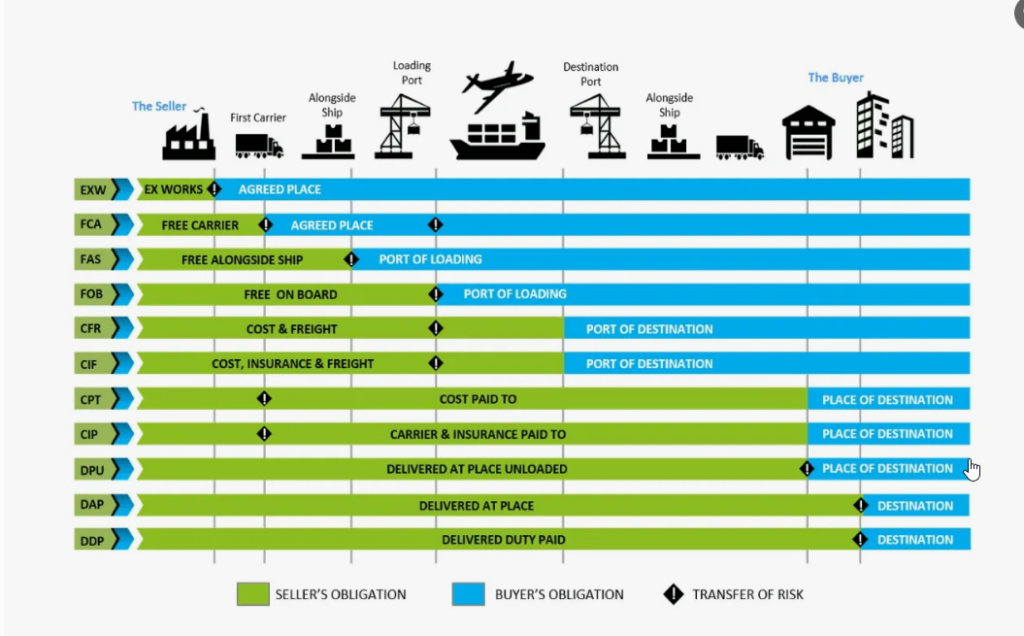
Incoterms Defined and Explained. The most recent edition of the ICC Incoterms® rules is Incoterms® 2020. It entered into force on 1 January 2020, and as of 2026 and 2027 it remains the current edition. It contains 11 fundamental rules.
Incoterms are essentially the grammar of international delivery: they tell the seller and buyer who arranges transport, who pays particular costs, where delivery occurs, and where the risk of loss or damage transfers. They do not, by themselves, determine the price of the goods, payment terms, transfer of ownership, or all other provisions of the sales contract.


5
The 11 Incoterms® 2020
They are divided into two families:
For any mode or combination of transport
- EXW — Ex Works
- FCA — Free Carrier
- CPT — Carriage Paid To
- CIP — Carriage and Insurance Paid To
- DAP — Delivered at Place
- DPU — Delivered at Place Unloaded
- DDP — Delivered Duty Paid
Specifically for sea and inland waterway transport
- FAS — Free Alongside Ship
- FOB — Free On Board
- CFR — Cost and Freight
- CIF — Cost Insurance and Freight
This division is fundamental: ICC explicitly distinguishes the seven multimodal rules from the four maritime rules. Incoterms Defined and Explained.
1. EXW — Ex Works
Basic idea:
The seller makes the goods available at its own premises or another named location. The buyer takes responsibility from there.
Story: Imagine a fertilizer producer in Bahrain has 5,000 tonnes of urea sitting in its warehouse. A buyer agrees:
EXW Bahrain warehouse, Incoterms® 2020
The seller essentially says: “The goods are ready. Come and collect them.”
The buyer arranges loading, export formalities where applicable, transportation, insurance, import procedures and delivery.
Under EXW, the seller does not even have to load the goods onto the collecting vehicle or clear them for export.
Risk transfers: At the named place when the goods are placed at the buyer’s disposal.
Typical character: Maximum responsibility for the buyer; minimum delivery responsibility for the seller.
2. FCA — Free Carrier
Basic idea:
The seller delivers the goods to a carrier or another person nominated by the buyer at a named place.
The story becomes more sophisticated.
Suppose a Kazakhstan producer sells steel to a European buyer:
FCA Almaty terminal, Incoterms® 2020
The seller gets the goods to the agreed place and completes the seller’s required export formalities. The buyer then takes responsibility for the main transportation.
The seller is no longer simply saying “come and collect it from my warehouse.” Instead, the seller participates in getting the goods into the export logistics chain.
FCA is one of the seven rules designed for any mode or combination of transport.
Risk transfers: When the seller delivers to the carrier/person at the agreed place.
Interesting 2020 feature: Incoterms 2020 specifically addressed the situation where the parties need an on-board bill of lading under FCA, particularly in transactions involving bank financing.
3. CPT — Carriage Paid To
Basic idea:
The seller pays for carriage to the named destination, but risk transfers much earlier, when the goods are handed over to the carrier.
This is one of the most important concepts to understand.
Imagine:
CPT Hamburg, Incoterms® 2020
A seller of sulphur (or sulfur) in Kazakhstan arranges and pays transportation all the way to Hamburg.
But that does not mean the seller bears the risk throughout the journey.
Once the goods are delivered to the carrier according to the rule, the risk passes to the buyer.
So there are two different journeys:
Cost journey: Seller → Hamburg
Risk journey: Seller → carrier
That apparent contradiction is one of the central ideas behind Incoterms.
4. CIP — Carriage and Insurance Paid To
CIP is similar to CPT, but the seller additionally has an obligation to obtain insurance for the buyer’s risk during carriage.
Imagine:
CIP Rotterdam, Incoterms® 2020
A chemical producer sells cargo, sulfur or urea, to an importer.
The seller:
- handles the agreed export obligations;
- contracts carriage to Rotterdam;
- pays the carriage;
- obtains the required insurance.
But risk still transfers when the goods are handed over to the carrier, rather than when they arrive in Rotterdam.
Incoterms 2020 placed particular attention on insurance differences between CIP and CIF, including different insurance coverage requirements.
5. DAP — Delivered at Place
Basic idea:
The seller takes the goods all the way to an agreed destination and makes them available to the buyer ready for unloading.
Imagine a container of industrial chemicals:
DAP buyer’s warehouse, Rotterdam, Incoterms® 2020
The seller organizes the international transportation and gets the cargo to the buyer’s warehouse.
But the seller doesn’t normally unload it.
The truck arrives:
“Here are your goods.”
The buyer is responsible for unloading and normally handles import clearance and import duties/taxes.
Risk transfers: At the destination, before unloading.
DAP therefore moves substantially more responsibility toward the seller than CPT.
6. DPU — Delivered at Place Unloaded
DPU is particularly interesting because it was renamed in Incoterms 2020.
The previous Incoterms 2010 term was DAT — Delivered At Terminal. In 2020, ICC changed it to DPU — Delivered at Place Unloaded, making clear that the destination does not have to be a terminal.
Imagine:
DPU fertilizer warehouse, Bucharest, Incoterms® 2020
The seller takes the goods to the agreed destination and unloads them.
Only after unloading has taken place does delivery occur and risk transfer.
That gives DPU a distinctive position:
DAP: Seller brings it there → buyer unloads.
DPU: Seller brings it there → seller unloads.
ICC describes DPU as the rule in which the seller delivers at destination after unloading.
7. DDP — Delivered Duty Paid
DDP is almost the opposite of EXW.
Imagine a manufacturer sells machinery from Asia to a customer in Europe:
DDP customer’s factory, Germany, Incoterms® 2020
The seller is responsible for getting the goods to the destination and dealing with the export and import side of the transaction, including applicable duties.
The buyer’s role is comparatively limited: receive the goods, normally after they have arrived ready for unloading.
It is therefore often described as the Incoterm putting the greatest delivery responsibility on the seller.
The seller must be capable of dealing with the import requirements of the destination country, which can be a significant practical issue.
8. FAS — Free Alongside Ship
Now we enter the maritime Incoterms.
FAS is designed for sea or inland waterway transportation.
Imagine a bulk carrier arriving at a port in the Gulf to load sulphur.
Under:
FAS Port of Bahrain, Incoterms® 2020
the seller brings the cargo alongside the vessel at the agreed port.
The cargo has reached the ship, but it has not yet been loaded aboard.
The story is therefore:
Seller → port → alongside vessel | Buyer takes over
Risk transfers when the goods are placed alongside the vessel.
ICC specifically identifies FAS, FOB, CFR and CIF as the four rules intended for sea and inland waterway transport.
9. FOB — Free On Board
FOB is perhaps the most famous maritime Incoterm.
Imagine a bulk cargo of sulphur:
FOB Mina Al Ahmadi, Incoterms® 2020
The seller brings the cargo to the vessel and loads it on board.
Once the goods are on board, delivery has occurred and risk transfers to the buyer.
The buyer then takes the voyage risk, while the buyer also arranges the main carriage.
The essential story is:
FAS: “I have brought the goods alongside your ship.”
FOB: “I have put the goods on your ship.”
ICC confirms that under FOB, the seller delivers when the goods are placed on board the vessel.
Important practical point
FOB is specifically a maritime rule. For containerized cargo, FCA is often the more appropriate conceptual starting point, because containers are commonly handed to a carrier at a terminal before the actual vessel-loading stage.
10. CFR — Cost and Freight
CFR takes the FOB concept one step further.
Suppose a Gulf producer sells sulphur to India:
CFR Mundra, India, Incoterms® 2020
The seller:
- gets the goods onto the vessel;
- pays the ocean freight to Mundra.
But risk transfers when the goods are loaded on board the vessel at the departure port.
So again we have the famous Incoterms distinction:
Seller pays freight to destination.
But:
Buyer bears the risk during the voyage.
That distinction is extremely important in commodity trading.
11. CIF — Cost, Insurance and Freight
CIF is the famous maritime counterpart to CIP.
Suppose:
CIF Mundra, India, Incoterms® 2020
The seller:
- loads the cargo aboard the vessel;
- pays the freight to the destination port;
- obtains the insurance required by the CIF rule.
But risk transfers when the goods are loaded aboard the vessel at the shipment port.
So the seller can be paying the freight and insurance while the buyer already bears the transit risk.
ICC expressly identifies CIF as one of the four maritime Incoterms.
The whole Incoterms system as a story
You can understand the 11 rules as a journey.
Imagine 10,000 tonnes of sulphur leaving a Gulf refinery and travelling to an international buyer.
The question is:
How far along the journey does the seller’s responsibility extend?
At one extreme:
EXW
“Come to my warehouse and take it.”
↓
FCA
“I will deliver it to your carrier.”
↓
CPT / CIP
“I will arrange and pay for transportation to the destination, although risk transfers earlier.”
↓
DAP
“I will bring it to your destination, ready for you to unload.”
↓
DPU
“I will bring it there and unload it.”
↓
DDP
“I will bring it there and handle the import/duty responsibilities.”
And for maritime bulk cargo:
FAS
“I’ll put it alongside the vessel.”
↓
FOB
“I’ll put it on board.”
↓
CFR
“I’ll put it on board and pay the freight.”
↓
CIF
“I’ll put it on board, pay the freight and provide the required insurance.”
That is the basic architecture of Incoterms 2020.
A very useful comparison for commodity trading
| Incoterm | Seller’s main delivery point | Seller pays main carriage? | Seller provides insurance? | Risk transfers roughly |
|---|---|---|---|---|
| EXW | Seller’s premises | No | No | At seller’s premises |
| FCA | Carrier / agreed place | Usually no | No | At carrier handover |
| CPT | Carrier, while carriage is paid to destination | Yes | No | At carrier handover |
| CIP | Carrier, while carriage is paid to destination | Yes | Yes | At carrier handover |
| DAP | Named destination, ready for unloading | Yes | No | At destination before unloading |
| DPU | Named destination, unloaded | Yes | No | After unloading |
| DDP | Named destination, import cleared/duties paid | Yes | No | At destination |
| FAS | Alongside vessel | No | No | Alongside vessel |
| FOB | On board vessel | No | No | On board vessel |
| CFR | On board vessel; freight paid to destination | Yes | No | On board vessel |
| CIF | On board vessel; freight + insurance | Yes | Yes | On board vessel |
The important caveat is that “seller pays transportation” and “seller bears transportation risk” are not necessarily the same thing. CPT, CIP, CFR and CIF are particularly good examples of that distinction.
One more important point for Solarim Trading
For a commodity business dealing with sulphur, urea, fertilizers and steel, the choice of Incoterm can substantially affect the commercial meaning of a quotation. A quotation such as:
Sulphur — USD ___ / MT CIF Mundra, Incoterms® 2020
is commercially very different from:
Sulphur — USD ___ / MT FOB Gulf Port, Incoterms® 2020
and different again from:
Sulphur — USD ___ / MT CFR Mundra, Incoterms® 2020.
The Incoterm should therefore be written together with the named place/port and the edition, e.g. “CIF Mundra Port, India, Incoterms® 2020”, rather than simply writing “CIF.”
For an authoritative reference, ICC’s official Incoterms 2020 material provides the complete rules and explanatory notes.
ICC — Incoterms® 2020 official page
ICC — Incoterms® 2020 Digital Library
ICC — Free Incoterms® 2020 practical wallchart
Solarim Trading – your reliable partner in the world of sulphur, urea, fertilizer and steel products.